LINZ. In April 2025, the leadership team of IT:U, together with Founding President Stefanie Lindstaedt, visited University of Technology Nuremberg (UTN) in Nuremberg to facilitate an initial exchange during the early development phase of both newly founded universities. Now, a delegation from University of Technology Nuremberg (UTN), led by its Founding President Michael Huth, traveled to Linz to gain deeper insights into IT:U on site.
Both universities have a legal and societal mandate to explore new approaches and structures for university learning, research, and transfer in the age of digitalization and artificial intelligence (AI). The exchange made clear that both institutions are pursuing this mission actively and with a high level of commitment.
The intensive discussions in Linz gave participants the opportunity to identify common aspects of the work involved in building new universities. These include:
the heavy workload resulting from simultaneously managing institutional development and growing day-to-day operations, as well as the difficulty of communicating these challenges externally,
a partly critical perception of the founding projects within their respective national higher education landscapes,
the ambition to strengthen excellent research, transfer, and learning equally while fostering interdisciplinary learning, and
the goal of establishing resilient and agile governance structures that support research and learning in a rapidly changing world.
The open exchange also highlighted significant differences between the two founding projects, including the following:
IT:U currently operates under a presidential governance model, whereas UTN has a Founding Executive Board and a Founding Steering Board,
at IT:U, learners are in a private-law relationship with the university, while at UTN they are in a public-law relationship,
at IT:U, employees are employed under private law, whereas at UTN the standard legal regulations governing public-sector and civil-service employment apply,
IT:U does not intend to establish faculties or departments, while UTN has departments in which professors are appointed, and
IT:U focuses strategically on “Computational X” and digital transformation, whereas UTN will implement its AI focus across five departments that, in addition to computer science, AI, the humanities, and the social sciences, also reflect the convergence of the physical and biological sciences.
IT:U and UTN view the identified similarities as fertile ground for collaboration. The recognized differences serve as a basis for jointly and constructively questioning strategic assumptions and as a “stress test” for the development of each institution’s profile.
A first collaboration between IT:U and UTN was signed in Linz on April 29, 2026, by Stefanie Lindstaedt and Michael Huth: an “Erasmus+ Mobility Programme for Higher Education,” which is intended to begin with an exchange of the first doctoral researchers from both founding universities.
IT:U Founding President Stefanie Lindstaedt summarized the visit as follows: “The key challenge is to embed new institutional models in reality in such a way that they do not become rigid like their predecessors, but instead remain permanently agile, bold, and capable of learning. Through intensive exchange with the leadership team at UTN, we were able to jointly reflect on the challenges that come with building entirely new universities and lay the foundation for tackling them together going forward.”
UTN Founding President Michael Huth described the visit as follows: “As a newly founded university, we benefit greatly from regular exchange with other founding projects and with universities that have achieved international excellence within just a few decades. IT:U is a particularly valuable partner for us because of its intended profile and unique legal framework, which help us make our respective development processes more effective together. At the same time, understanding our differences helps us review and validate our own strategy and institutional profile. We look forward to our next joint activities.”
Among the UTN representatives traveling to Linz were Founding President Prof. Dr. Michael Huth and Vice Presidents Prof. Dr. Isa Jahnke and Prof. Dr. Alexander Martin.
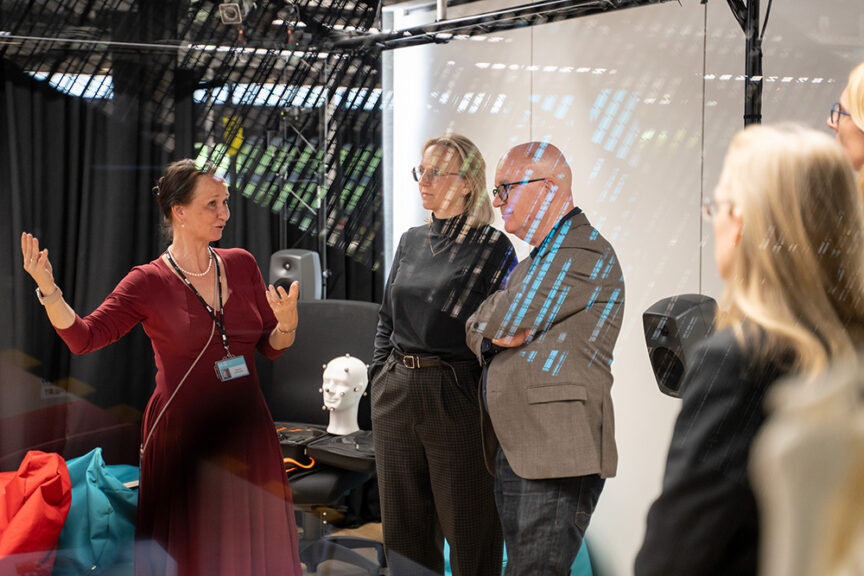
IT:U Founding President Stefanie Lindstaedt presents the university’s concept to the UTN delegation. The discussions highlighted both similarities and differences between the two institutions.
The University of Technology Nuremberg (UTN), founded in 2021, is the first newly established public university in Bavaria since 1978. The UTN is a living laboratory building a university for the age of AI and the rapidly advancing changes in technology, business and society. The UTN strives to become a strong regional force in research, teaching and transfer and an internationally leading university of the 21st century with regional roots and a global outlook.
The 37-hectare, sustainable UTN campus will form the center of the new Lichtenreuth district in Nuremberg, close to the historic city center. Around 6,000 students, 200 professors and at least 2,000 employees will study and work there. Study programs will integrate aspects of technology, liberal arts, social sciences and natural sciences to ideally prepare students for the interdisciplinary requirements of the new world of work.

LINZ. In April 2025, the leadership team of IT:U, together with Founding President Stefanie Lindstaedt, visited University of Technology Nuremberg (UTN) in Nuremberg to facilitate an initial exchange during the early development phase of both newly founded universities. Now, a delegation from University of Technology Nuremberg (UTN), led by its Founding President Michael Huth, traveled to Linz to gain deeper insights into IT:U on site.
Both universities have a legal and societal mandate to explore new approaches and structures for university learning, research, and transfer in the age of digitalization and artificial intelligence (AI). The exchange made clear that both institutions are pursuing this mission actively and with a high level of commitment.
The intensive discussions in Linz gave participants the opportunity to identify common aspects of the work involved in building new universities. These include:
The open exchange also highlighted significant differences between the two founding projects, including the following:
IT:U and UTN view the identified similarities as fertile ground for collaboration. The recognized differences serve as a basis for jointly and constructively questioning strategic assumptions and as a “stress test” for the development of each institution’s profile.
A first collaboration between IT:U and UTN was signed in Linz on April 29, 2026, by Stefanie Lindstaedt and Michael Huth: an “Erasmus+ Mobility Programme for Higher Education,” which is intended to begin with an exchange of the first doctoral researchers from both founding universities.
IT:U Founding President Stefanie Lindstaedt summarized the visit as follows: “The key challenge is to embed new institutional models in reality in such a way that they do not become rigid like their predecessors, but instead remain permanently agile, bold, and capable of learning. Through intensive exchange with the leadership team at UTN, we were able to jointly reflect on the challenges that come with building entirely new universities and lay the foundation for tackling them together going forward.”
UTN Founding President Michael Huth described the visit as follows: “As a newly founded university, we benefit greatly from regular exchange with other founding projects and with universities that have achieved international excellence within just a few decades. IT:U is a particularly valuable partner for us because of its intended profile and unique legal framework, which help us make our respective development processes more effective together. At the same time, understanding our differences helps us review and validate our own strategy and institutional profile. We look forward to our next joint activities.”
Press Photos for Download:
Conversation Between Founding Presidents Huth and Lindstaedt (Copyright: I:TU)
Group Photo on the Stairs (Copyright: I:TU)
Group Discussion (Copyright: I:TU)
About the University of Technology Nuremberg
The University of Technology Nuremberg (UTN), founded in 2021, is the first newly established public university in Bavaria since 1978. The UTN is a living laboratory building a university for the age of AI and the rapidly advancing changes in technology, business and society. The UTN strives to become a strong regional force in research, teaching and transfer and an internationally leading university of the 21st century with regional roots and a global outlook.
The 37-hectare, sustainable UTN campus will form the center of the new Lichtenreuth district in Nuremberg, close to the historic city center. Around 6,000 students, 200 professors and at least 2,000 employees will study and work there. Study programs will integrate aspects of technology, liberal arts, social sciences and natural sciences to ideally prepare students for the interdisciplinary requirements of the new world of work.
Contact
Peter Diehl
Communication Unit