How can both universities create greater impact together? This question was at the center of the joint executive retreat of the University of Technology Nuremberg (UTN) and Friedrich-Alexander-Universität Erlangen-Nürnberg (FAU), which took place in Erlangen on June 3. The leadership teams of both universities discussed current developments in the metropolitan region and across Bavaria, as well as opportunities for collaboration in research, learning and teaching, and infrastructure.
For UTN, collaboration with FAU is an important component of its development as a young university with a clear focus on artificial intelligence, internationally excellent research, interdisciplinary learning, and societal impact. In particular, the National High-Performance Computing Center Erlangen (NHR@FAU) and the support provided by the Erlangen Regional Computing Center create important conditions for excellent research in Northern Bavaria and for implementing UTN’s strategic focus on AI. The strong partnership between FAU and UTN is also reflected in FAU’s provision of course offerings for UTN.
Prof. Dr. Michael Huth stated: “A strong capacity for innovation is found in regions or large urban environments where there is a high concentration of institutions and talent—such as in the Nuremberg Metropolitan Region. We are unlocking this potential through the development of UTN’s distinctive profile and continued growth, as well as through collaborations such as our partnership with FAU, multiplying our respective strengths for the benefit of the metropolitan region and Bavaria. We are grateful for the support FAU has already provided during the first five years of our development.”
In addition to the existing collaborations, FAU President Prof. Dr. Joachim Hornegger sees further potential for synergies between the two universities: “One area is learning and teaching, where we can ensure greater mobility and flexibility for our students between the two institutions. The second area is research. I see tremendous opportunities for submitting joint research proposals and competing together in the international research landscape.”
Prof. Dr. Huth added: “Additional opportunities for collaboration have been identified, including the development of AI competencies, which would benefit all students at FAU and UTN. Collaborative initiatives will appropriately take into account the distinctive characteristics of both universities, including UTN’s learning and teaching concept.”
The leadership teams of both universities remain in regular informal exchange to advance existing and planned collaborative initiatives.

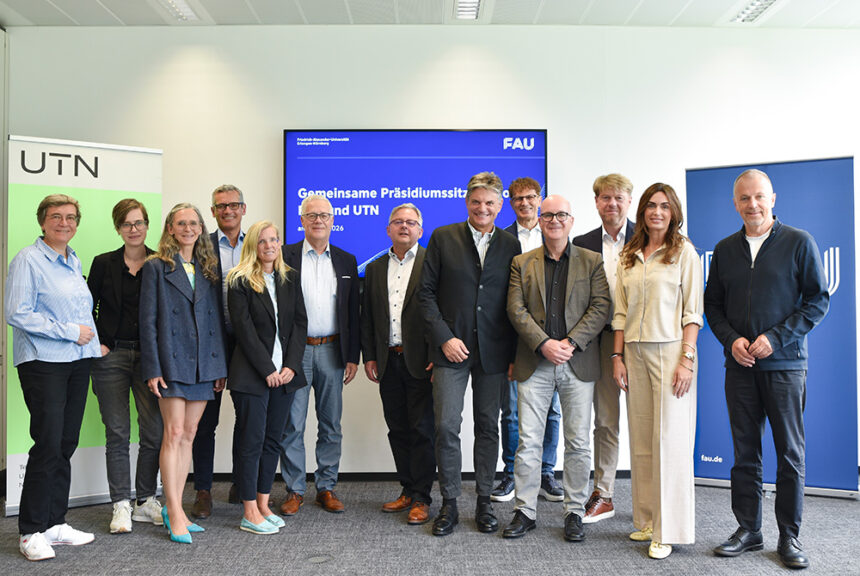
How can both universities create greater impact together? This question was at the center of the joint executive retreat of the University of Technology Nuremberg (UTN) and Friedrich-Alexander-Universität Erlangen-Nürnberg (FAU), which took place in Erlangen on June 3. The leadership teams of both universities discussed current developments in the metropolitan region and across Bavaria, as well as opportunities for collaboration in research, learning and teaching, and infrastructure.
For UTN, collaboration with FAU is an important component of its development as a young university with a clear focus on artificial intelligence, internationally excellent research, interdisciplinary learning, and societal impact. In particular, the National High-Performance Computing Center Erlangen (NHR@FAU) and the support provided by the Erlangen Regional Computing Center create important conditions for excellent research in Northern Bavaria and for implementing UTN’s strategic focus on AI. The strong partnership between FAU and UTN is also reflected in FAU’s provision of course offerings for UTN.
Prof. Dr. Michael Huth stated: “A strong capacity for innovation is found in regions or large urban environments where there is a high concentration of institutions and talent—such as in the Nuremberg Metropolitan Region. We are unlocking this potential through the development of UTN’s distinctive profile and continued growth, as well as through collaborations such as our partnership with FAU, multiplying our respective strengths for the benefit of the metropolitan region and Bavaria. We are grateful for the support FAU has already provided during the first five years of our development.”
In addition to the existing collaborations, FAU President Prof. Dr. Joachim Hornegger sees further potential for synergies between the two universities: “One area is learning and teaching, where we can ensure greater mobility and flexibility for our students between the two institutions. The second area is research. I see tremendous opportunities for submitting joint research proposals and competing together in the international research landscape.”
Prof. Dr. Huth added: “Additional opportunities for collaboration have been identified, including the development of AI competencies, which would benefit all students at FAU and UTN. Collaborative initiatives will appropriately take into account the distinctive characteristics of both universities, including UTN’s learning and teaching concept.”
The leadership teams of both universities remain in regular informal exchange to advance existing and planned collaborative initiatives.