Around 600 visitors attended the 19th Science Day of the Nuremberg Metropolitan Region at the Technische Hochschule Nürnberg Georg Simon Ohm (the Ohm). Under this year’s theme, “AI and Robotics – People, Machines, Possibilities,” representatives from academia, industry, and politics came together to discuss scientific trends, real-world applications, and the societal implications of artificial intelligence and robotics.
For the third time, the Forum Wissenschaft of the Nuremberg Metropolitan Region hosted the Science Day in Nuremberg. This year’s event was organized in cooperation with Technische Hochschule Nürnberg Georg Simon Ohm (the Ohm) and the University of Technology Nuremberg (UTN) as the academic hosts, with the City of Nuremberg serving as the municipal partner. “As hosts, we are delighted to welcome leading minds from academia, industry, and politics together with UTN,” said Ohm President Prof. Dr. Niels Oberbeck. “The Ohm is known for practice-oriented research and strong regional partnerships—qualities that are reflected in this event. Science Day provides an ideal platform to showcase innovations in artificial intelligence and robotics and help bring them into real-world applications.”
To open the event, Marcus König, Lord Mayor of the City of Nuremberg, Prof. Dr. Niels Oberbeck, and Prof. Dr. Alexander Martin, Founding Vice President for Research, Innovation and Entrepreneurship at UTN, highlighted the opportunities that artificial intelligence and robotics offer for the region. “This year’s theme, ‘AI and Robotics – People, Machines, Possibilities,’ is a perfect fit for Nuremberg. As a leading center for science and innovation, we provide the ideal conditions for developing new technologies responsibly and successfully translating them into practice. Together with our universities, research institutions, and innovative companies, we are helping to shape the future while strengthening the long-term competitiveness of our city and region,” said Marcus König, Lord Mayor of the City of Nuremberg.
A Unique Ecosystem of Universities, Research, and Industry
The close integration of applied research, the development of a new university, and the region’s innovative strength was a recurring theme throughout the opening remarks. “The Nuremberg Metropolitan Region is exceptionally well positioned in the field of artificial intelligence. This is made possible by the close collaboration between universities, research institutions, and industry. Particularly in AI, these partnerships lead to tangible projects with a significant impact on business and society. The fact that scientific excellence is found across multiple institutions makes our region one of Germany’s most exciting centers for innovation,” said Prof. Dr. Alexander Martin.
In their welcome addresses, Bavaria’s Minister of Science and the Arts Markus Blume and Dr. Silke Launert, Parliamentary State Secretary to the Federal Minister of Research, Technology and Space, highlighted artificial intelligence and robotics as key fields for innovation, technology transfer, and Germany’s long-term technological competitiveness. “Progress and Franconia have always gone hand in hand. Strong universities, innovative companies, and a confident Nuremberg Metropolitan Region: the Science Day is an event by the region, for the region—with an impact that reaches far beyond it. It brings together everyone from startup founders to leading researchers—people who don’t just complain but take action. And that matters more than ever today. Our world is undergoing profound change. Robotics and artificial intelligence are driving a revolution. For us, one thing is clear: only by keeping pace with these developments and helping shape them can we secure prosperity and sovereignty. That is why, through the Hightech Agenda Bavaria, we are investing 5.5 billion euros in talent, technology, and transfer. We are turning cutting-edge research into innovation—and artificial intelligence into new industries,” said Bavaria’s Minister of Science, Markus Blume.
AI Is Shaping the Factory of Tomorrow
The two keynote speakers then explored specific fields of application. Dr. Horst J. Kayser (Siemens AG, CEO Digital Industries Factory Automation) demonstrated how physical AI is shaping the factory of tomorrow and enabling people and machines to work together in manufacturing. “The demands on industrial manufacturing are high. Sustainable production and the need to respond quickly to changing market conditions, while addressing the ongoing shortage of skilled workers, require a new way of thinking. The factory of the future, where machines support people, will help secure jobs,” said Dr. Horst J. Kayser.
Prof. Dr. Yasmin Mei-Yee Weiß (the Ohm, Professor of Artificial Intelligence in the Workplace) examined how AI is reshaping workplace skills and why success will increasingly depend on using technology with confidence rather than simply mastering it. According to her, tomorrow’s top talent will integrate AI naturally into everyday workflows and ways of thinking. The key will be “dual collaboration skills”—the ability to work equally well with people and with AI.
Turning AI into a Practical Tool: Panel on Real-World AI Applications Draws Strong Interest
In the afternoon, five parallel expert panels explored the conference theme from different perspectives, covering topics ranging from skills for the AI-driven workplace and humanoid robotics to the transformation of the media industry and the future of medicine. The panel “From Data Overload to Knowledge Advantage – AI in Practice” attracted the largest audience. Its popularity reflected its relevance for the region’s many small and medium-sized enterprises, which are increasingly looking beyond the hype to identify practical ways of using AI in their day-to-day operations. Drawing on real-world projects from the Ohm’s Digital Intelligence Technology Transfer Center, the session demonstrated how SMEs are turning AI from an abstract buzzword into a practical tool—from automated quality inspection to chatbots. Across all panels, experts from academia and industry discussed not only the technical possibilities of AI and robotics but also the ethical and societal questions surrounding their use.
The event concluded with a performance by the Nuremberg University of Music, featuring an improvisation combining saxophone and robo-percussion—a symbolic collaboration between humans and machines.
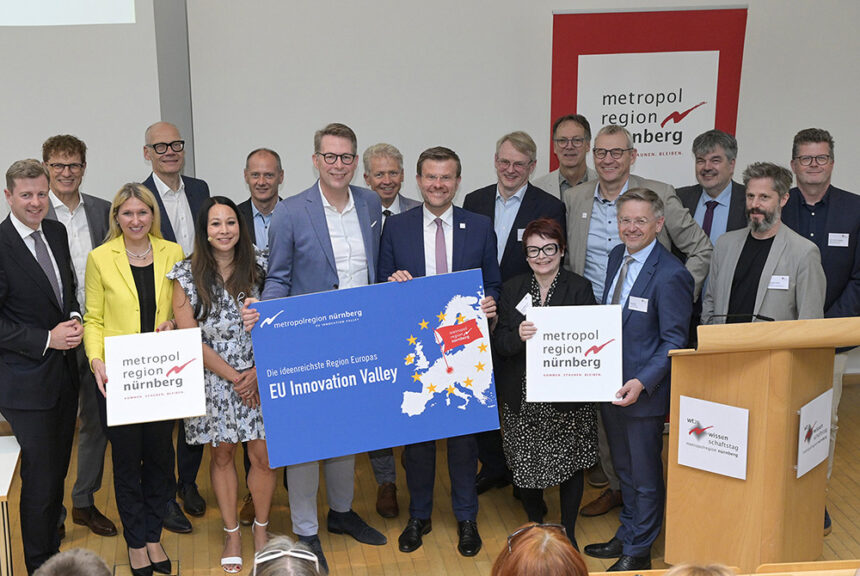
For Dr. Thomas Koch, Managing Director of the Nuremberg Metropolitan Region, the conclusion of the Science Day was clear: “Our region became an EU Innovation Valley because science and industry complement each other so successfully here. Our shared task now is to further build on this EU distinction.”
Press Photos for Download:
Group Photo (Copyright: Rudi Ott)
Keynote by Prof. Dr. Yasmin Mei-Yee Weiß (Copyright: Rudi Ott)
Welcome Address by Markus Blume, Bavarian Minister of Science and the Arts (Copyright: Rudi Ott)
Welcome Address by Dr. Silke Launert, Parliamentary State Secretary at the Federal Ministry of Research, Technology and Space (Copyright: Rudi Ott)
Robot at the Siemens Booth (Copyright: Rudi Ott)
About the University of Technology Nuremberg
The University of Technology Nuremberg (UTN), founded in 2021, is the first newly established public university in Bavaria since 1978. The UTN is a living laboratory building a university for the age of AI and the rapidly advancing changes in technology, business and society. The UTN strives to become a strong regional force in research, teaching and transfer and an internationally leading university of the 21st century with regional roots and a global outlook.
The 37-hectare, sustainable UTN campus will form the center of the new Lichtenreuth district in Nuremberg, close to the historic city center. Around 6,000 students, 200 professors and at least 2,000 employees will study and work there. Study programs will integrate aspects of technology, liberal arts, social sciences and natural sciences to ideally prepare students for the interdisciplinary requirements of the new world of work.
Contact
Head of UnitCommunication Unit

Around 600 visitors attended the 19th Science Day of the Nuremberg Metropolitan Region at the Technische Hochschule Nürnberg Georg Simon Ohm (the Ohm). Under this year’s theme, “AI and Robotics – People, Machines, Possibilities,” representatives from academia, industry, and politics came together to discuss scientific trends, real-world applications, and the societal implications of artificial intelligence and robotics.
For the third time, the Forum Wissenschaft of the Nuremberg Metropolitan Region hosted the Science Day in Nuremberg. This year’s event was organized in cooperation with Technische Hochschule Nürnberg Georg Simon Ohm (the Ohm) and the University of Technology Nuremberg (UTN) as the academic hosts, with the City of Nuremberg serving as the municipal partner. “As hosts, we are delighted to welcome leading minds from academia, industry, and politics together with UTN,” said Ohm President Prof. Dr. Niels Oberbeck. “The Ohm is known for practice-oriented research and strong regional partnerships—qualities that are reflected in this event. Science Day provides an ideal platform to showcase innovations in artificial intelligence and robotics and help bring them into real-world applications.”
To open the event, Marcus König, Lord Mayor of the City of Nuremberg, Prof. Dr. Niels Oberbeck, and Prof. Dr. Alexander Martin, Founding Vice President for Research, Innovation and Entrepreneurship at UTN, highlighted the opportunities that artificial intelligence and robotics offer for the region. “This year’s theme, ‘AI and Robotics – People, Machines, Possibilities,’ is a perfect fit for Nuremberg. As a leading center for science and innovation, we provide the ideal conditions for developing new technologies responsibly and successfully translating them into practice. Together with our universities, research institutions, and innovative companies, we are helping to shape the future while strengthening the long-term competitiveness of our city and region,” said Marcus König, Lord Mayor of the City of Nuremberg.
A Unique Ecosystem of Universities, Research, and Industry
The close integration of applied research, the development of a new university, and the region’s innovative strength was a recurring theme throughout the opening remarks. “The Nuremberg Metropolitan Region is exceptionally well positioned in the field of artificial intelligence. This is made possible by the close collaboration between universities, research institutions, and industry. Particularly in AI, these partnerships lead to tangible projects with a significant impact on business and society. The fact that scientific excellence is found across multiple institutions makes our region one of Germany’s most exciting centers for innovation,” said Prof. Dr. Alexander Martin.
In their welcome addresses, Bavaria’s Minister of Science and the Arts Markus Blume and Dr. Silke Launert, Parliamentary State Secretary to the Federal Minister of Research, Technology and Space, highlighted artificial intelligence and robotics as key fields for innovation, technology transfer, and Germany’s long-term technological competitiveness. “Progress and Franconia have always gone hand in hand. Strong universities, innovative companies, and a confident Nuremberg Metropolitan Region: the Science Day is an event by the region, for the region—with an impact that reaches far beyond it. It brings together everyone from startup founders to leading researchers—people who don’t just complain but take action. And that matters more than ever today. Our world is undergoing profound change. Robotics and artificial intelligence are driving a revolution. For us, one thing is clear: only by keeping pace with these developments and helping shape them can we secure prosperity and sovereignty. That is why, through the Hightech Agenda Bavaria, we are investing 5.5 billion euros in talent, technology, and transfer. We are turning cutting-edge research into innovation—and artificial intelligence into new industries,” said Bavaria’s Minister of Science, Markus Blume.
AI Is Shaping the Factory of Tomorrow
The two keynote speakers then explored specific fields of application. Dr. Horst J. Kayser (Siemens AG, CEO Digital Industries Factory Automation) demonstrated how physical AI is shaping the factory of tomorrow and enabling people and machines to work together in manufacturing. “The demands on industrial manufacturing are high. Sustainable production and the need to respond quickly to changing market conditions, while addressing the ongoing shortage of skilled workers, require a new way of thinking. The factory of the future, where machines support people, will help secure jobs,” said Dr. Horst J. Kayser.
Prof. Dr. Yasmin Mei-Yee Weiß (the Ohm, Professor of Artificial Intelligence in the Workplace) examined how AI is reshaping workplace skills and why success will increasingly depend on using technology with confidence rather than simply mastering it. According to her, tomorrow’s top talent will integrate AI naturally into everyday workflows and ways of thinking. The key will be “dual collaboration skills”—the ability to work equally well with people and with AI.
Turning AI into a Practical Tool: Panel on Real-World AI Applications Draws Strong Interest
In the afternoon, five parallel expert panels explored the conference theme from different perspectives, covering topics ranging from skills for the AI-driven workplace and humanoid robotics to the transformation of the media industry and the future of medicine. The panel “From Data Overload to Knowledge Advantage – AI in Practice” attracted the largest audience. Its popularity reflected its relevance for the region’s many small and medium-sized enterprises, which are increasingly looking beyond the hype to identify practical ways of using AI in their day-to-day operations. Drawing on real-world projects from the Ohm’s Digital Intelligence Technology Transfer Center, the session demonstrated how SMEs are turning AI from an abstract buzzword into a practical tool—from automated quality inspection to chatbots. Across all panels, experts from academia and industry discussed not only the technical possibilities of AI and robotics but also the ethical and societal questions surrounding their use.
The event concluded with a performance by the Nuremberg University of Music, featuring an improvisation combining saxophone and robo-percussion—a symbolic collaboration between humans and machines.
For Dr. Thomas Koch, Managing Director of the Nuremberg Metropolitan Region, the conclusion of the Science Day was clear: “Our region became an EU Innovation Valley because science and industry complement each other so successfully here. Our shared task now is to further build on this EU distinction.”
Press Photos for Download:
Group Photo (Copyright: Rudi Ott)
Keynote by Prof. Dr. Yasmin Mei-Yee Weiß (Copyright: Rudi Ott)
Welcome Address by Markus Blume, Bavarian Minister of Science and the Arts (Copyright: Rudi Ott)
Welcome Address by Dr. Silke Launert, Parliamentary State Secretary at the Federal Ministry of Research, Technology and Space (Copyright: Rudi Ott)
Robot at the Siemens Booth (Copyright: Rudi Ott)
About the University of Technology Nuremberg
The University of Technology Nuremberg (UTN), founded in 2021, is the first newly established public university in Bavaria since 1978. The UTN is a living laboratory building a university for the age of AI and the rapidly advancing changes in technology, business and society. The UTN strives to become a strong regional force in research, teaching and transfer and an internationally leading university of the 21st century with regional roots and a global outlook.
The 37-hectare, sustainable UTN campus will form the center of the new Lichtenreuth district in Nuremberg, close to the historic city center. Around 6,000 students, 200 professors and at least 2,000 employees will study and work there. Study programs will integrate aspects of technology, liberal arts, social sciences and natural sciences to ideally prepare students for the interdisciplinary requirements of the new world of work.
Contact
Peter Diehl
Communication Unit