

Interdisciplinary research on human and artificial intelligence from three perspectives
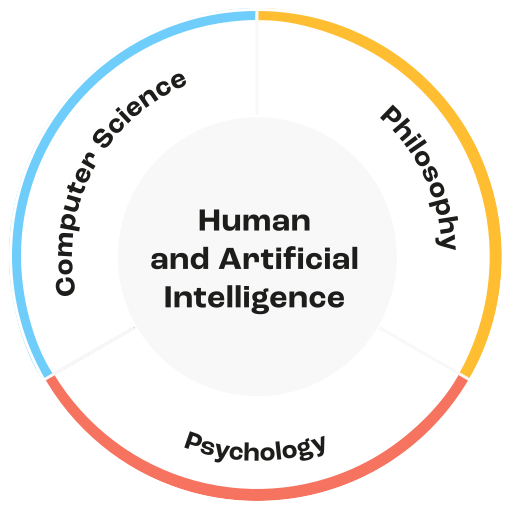
The English-language Master’s program Human and Artificial Intelligence connects computer science, psychology and philosophy and offers new perspectives on human cognition and artificial intelligence.
Do you want to not only understand what defines the human mind but also how to manage artificial intelligence responsibly? This holistic perspective is more crucial than ever – in science, business and governance.
Whether your focus is on computer science, psychology or philosophy or opt for a fully interdisciplinary approach, this program will allow you to build on your knowledge from your Bachelor’s degree, while developing new ideas across disciplines. You will transform these ideas into solutions and critically examine their social impact. By tailoring your course selection, you can shape both the interdisciplinary range and subject-specific depth individually to match your interests and goals.
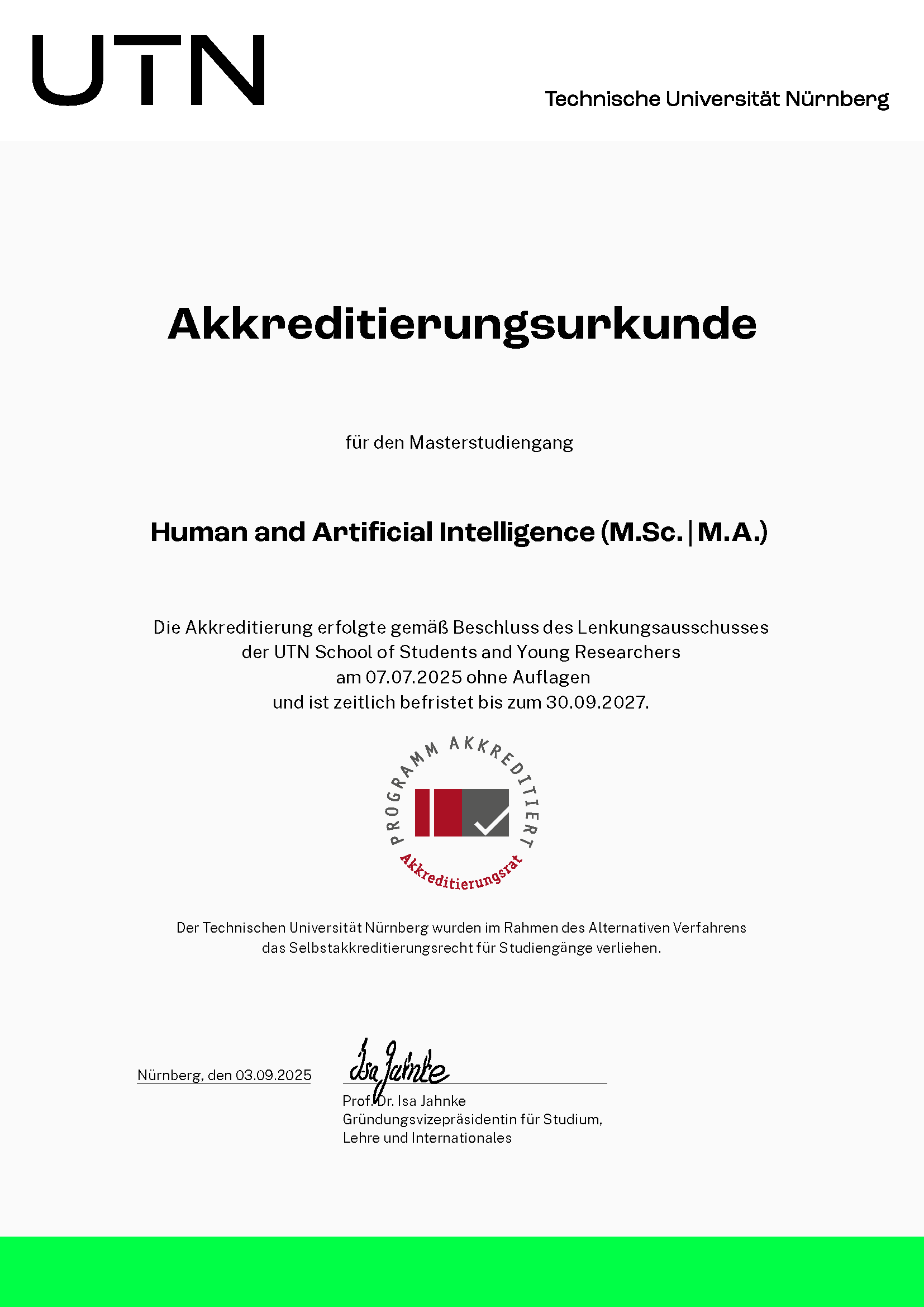
The degree program is accredited. View document.
Not in the mood for a long search? Jump straight to the admission requirements.
Learn more about our master’s program
Your benefits at the UTN

Our close supervision ratio is one of the best in Germany. You will quickly get to know the professors personally.

Our learning design with small seminar groups and new forms of examination ensures digital and state-of-the-art university teaching.

Develop a profile that aligns with your goals through an individual track: from key skills to research focus.

Learn to cross disciplinary boundaries and discover solution-oriented and interdisciplinary collaboration in teaching and research.

The city of Nuremberg is a hidden champion with diverse career opportunities and a high quality of life.

Psychology
Understanding human intelligence and interaction
The origin of artificial intelligence is in the imitation and deeper understanding of human intelligence. You will explore how cognitive processes such as learning, problem solving and language shape humans and their interaction with the world.
Psychology also opens your eyes to the mechanisms that shape human interaction with AI systems, such as emotions and social influences. How do we as humans react to AI? Under what circumstances do acceptance and trust arise in human-machine interaction? You’ll get the tools to better understand the difference between human and artificial intelligence and how they can better interact with each other.
Philosophy
Reflecting and contextualizing human and artificial intelligence
The development and use of artificial intelligence raises the big questions facing humanity and society. How can an increasingly intelligent and autonomous technology be guided by ethical values and what are they?
With your philosophical knowledge, you not only question the development of AI, but also give it a direction: trustworthy, reflective and socially relevant. You combine theory and practice and apply your insights to the development of artificial intelligence. The context for this is always the larger perspective of what human thinking and cognition is.


Computer science
Designing and developing artificial intelligence
Here you will learn all about artificial intelligence – and what is necessary to actively shape the development of AI. From machine learning and training neural networks to data processing and analysis – you will learn the important techniques and tools for this.
However, the focus of this Master’s program is about more than just programming: you will learn about the potential but also the current limitations of AI, its algorithms and its interaction with human actors. By combining practice and theory, you will be prepared to create innovative and powerful systems that can solve complex problems. Your knowledge of computer science will become the foundation for a new generation of AI – intelligent, adaptable and cutting-edge.
Key Data
| Degree program | Human and Artificial Intelligence (M.Sc. / M.A.) |
| Required course work | 4 semesters (full-time studies, approx. 40 hours per week, with 120 ECTS) |
| Location | Nuremberg |
| Language | English |
| Application period | March 1, 2026 until and including May 31, 2026 |
| Enrollment period | May 1, 2026 until and including September 30, 2026 |
| Semester period | October 1, 2026 until March 31, 2027 |
| Course period | Expected October 12, 2026 until and including February 5, 2027 |
| Welcome Week for new students | Expected October 5, 2026 until and including October 9, 2026 |
A detailed overview of the course schedule can be found in the following PDF list: Download
Learn More: Online Info Sessions About Studying at UTN
Would you like to learn more about studying at UTN? Our online info sessions offer a concise overview of our degree programs, the application process, and what it’s like to study and learn at UTN.
Study Program concept
Our innovative teaching and learning approach is based on extensive research findings and allows you to participate actively in the learning process and reflect on your learning activities. Instead of just learning by heart, you will complete learning-oriented tasks throughout the semester and receive regular personal feedback on your progress from the lecturers.
Find more information about our unique learning design here:
Curriculum
Laying the foundations together
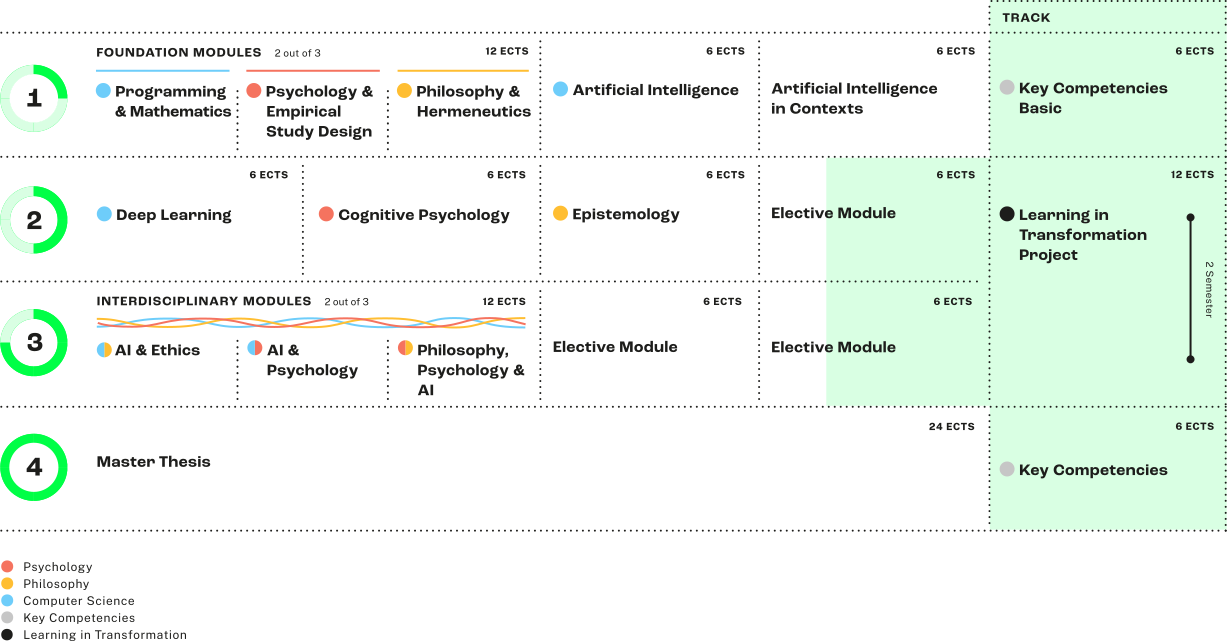
In the first semester, you lay the foundation for your studies. Through the Foundation Modules, you strategically expand your knowledge in subject areas that are new to you. During the admission process, it is assessed which modules will help you build a solid base. Additionally, you will engage with artificial intelligence in two modules: You will not only learn the technical basics, but also understand the social and legal contexts that shape artificial intelligence and its use.
Deepen your specialist knowledge
You deepen your knowledge in the three core disciplines of philosophy, psychology, and computer science. At the same time, you begin to shape your individual profile: with your first Elective Module, you can take advantage of the broad course offerings at UTN. Whether you choose a disciplinary focus, which will be shown on your Master’s certificate, or make interdisciplinarity your own program – the choice is yours. Your academic mentor will support you.
Additionally, you will start the Learning in Transformation Project with your fellow students: Over two semesters, theory and practice will be connected as you apply your knowledge to real-world projects and exchange experiences during courses.
Find interdisciplinary solutions and build your profile
Now the heart of the Master’s program awaits you: the combination of disciplines in interdisciplinary dialogue. In the modules “AI & Ethics”, “AI & Psychology” and “Philosophy, Psychology & AI”, you and your fellow students will always work with two professors from different disciplines on real-life research questions. At the same time, you develop your profile further by choosing additional elective modules – according to your interests and goals.
Your successful Master’s degree
In your Master’s thesis, you address a research question and find the answer to it. Your degree not only reflects your individually designed study profile, but also shows that you can look beyond your own disciplinary horizons and enter into a dialog with different disciplines.
Keep an eye on your career and develop yourself further
In addition to the core modules, you can prepare for your professional future in the Key Competencies modules. Whether it’s programming skills, key competencies, or entrepreneurial thinking – these modules will optimally prepare you for your career.
Admission Requirements
- Bachelor’s degree (B.Sc., B.A. or equivalent) in at least one of the following subject areas:
- Computer science
- Psychology
- Philosophy
- as well as related or interdisciplinary subjects or departments.
- Excellent knowledge in at least one of the above subject areas:
- The knowledge should comprise a total of at least 60 ECTS credits in one or more of these subject areas. If no ECTS credits are specified, this corresponds to the equivalent of a full academic year.
- In particular, the knowledge must also cover the methods and scientific principles of the respective subject area.
- Excellent knowledge in at least one of the above subject areas:
- Proficiency in English
- TOEFL internet based (min. 90 Points)
- IELTS (min. overall score 6.5)
- Cambridge Language Assessment (C1 Advanced)
- German Abitur with proof of English
- Bachelor’s program entirely conducted in English
- Successful participation in the aptitude assessment procedure.
Necessary Documents
- Complete, chronological, tabular CV in English
- Certificate of the university entrance qualification
- Certificate of the bachelor’s degree
If the degree certificate is not yet available, it can be submitted up to 5 weeks after start of the semester at the latest. - Transcript of records / overview of courses
- Optional: Diploma supplement / curriculum / module overview
- Explanatory letter in English (max. 600 words)
Your explanatory letter is part of the aptitude assessment by the selection committee. Describe your specific interest as well as your particular talent and motivation for the degree program. You can also mention any involvement with subject-specific or interdisciplinary aspects outside of your studies. You can also list relevant internships or course-specific vocational training. We would also like to know how and why our teaching and learning concept is beneficial for your skill development. - Language certificate English
You can prove your language skills with a German Abitur with a certificate in English or the completion of a Bachelor’s degree course taught entirely in English. You can also present a successfully completed language test that is no more than two years old. We will accept the following certificates: TOEFL internet-based min. 90 points, TOEFL computer-based min. 233 points, IELTS min. overall score 6.5, Cambridge language assessment C1 advanced. - Language certificate German A2 or German-language university entrance qualification
The proof can also be submitted later up to the registration of the final paper (beginning of 4th semester). If a language test is already submitted for the application or enrollment, it must not be older than two years. - Optional: Additional supporting documents
For example relevant internships or work experience. - APS certificate
An APS certificate is necessary if you obtained your university degree in India, China or Vietnam.
You can always refer to the General Study and Examination Regulations (Allgemeine Studien- und Prüfungsordnung) as well as the Aptitude Regulations (Satzung zum Eignungsverfahren) to read all admission requirements. Both documents can be found in the Legal Documents section (German only). Further information can also be found in our FAQ.
Do you meet the requirements?
Join a new university and apply now for the Master’s program Human and Artificial Intelligence (M.Sc. / M.A.)!
Do you have any questions?
If you have any queries regarding the Human and Artificial Intelligence (M.Sc. / M.A.) degree program,
please contact the Student Advisory Service. We are more than happy to assist you!
Here you can find additional information about the Departments: