
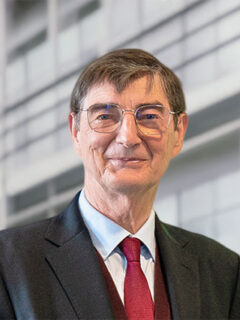
Prof. Dr. Miklós Rédei
Liberal Arts and Social Sciences
About
Miklós Rédei is a Visiting Professor at the University of Technology Nuremberg (UTN) for the 2025–2026 academic year. He is Professor of Philosophy at the London School of Economics and Political Science (LSE), where he is affiliated with the Department of Philosophy, Logic and Scientific Method.
His research focuses on foundational and philosophical questions in modern physics, particularly quantum mechanics and quantum field theory, as well as quantum logic, the interpretation of probability, and theories of probabilistic causation. His work also explores the connections between formal methods in mathematical physics and conceptual and methodological issues in the philosophy of science.
Before joining LSE in 2007, he held positions at Eötvös Loránd University in Budapest, Hungary, in the Departments of Logic and History and Philosophy of Science.
Research Seminar
Philosophy of Science & Formal Epistemology
Chance as a Guide to Life
Do. 7. Mai 2026, 17:00-18:30 CEST, Ulmenstrasse 52i, Ground Floor, Meeting Room 02
Richard Bradley (LSE, London)
When choosing between actions having the same two possible outcomes, we should choose the act for which the conditional chance of the preferred outcome, given its performance, is higher. This simple principle is, I argue, both a basic condition of instrumental rationality and the core of our conception of chance. To support this claim, I show that it in the presence of very weak rationality conditions on choice, the principle implies (1) a version of Lewis’ Principal Principle (and that the converse is false), (2) Stochastic Dominance, a principle endorsed by most theories of rational decision making under risk, and (3) that the evidential and causal decision values of an act, conditional on the chances, are the same. Finally, I argue that its appeal as a principle of instrumental rationality derives from the fact that securing a higher chance of a good outcome is better than securing a lower one.
Foundationalism and the Axioms of Mathematics
Do. 28. Mai 2026, 17:00-18:30 CEST, Ulmenstrasse 52i, Ground Floor, Meeting Room 02
Wesley Wrigley (Archives Henri-Poincaré (CNRS) Nancy, France)
Epistemic foundationalism typically appears in the philosophy of mathematics as the view that mathematical knowledge is based on watertight deduction from the axioms, which are themselves self-evident, and hence do not require a proof in order to be known. This view, known as the Euclidean Programme, was dominant for over 2,000 years in the West, but no longer enjoys widespread support among philosophers of mathematics. Although there is now broad agreement that the Euclidean Programme is not correct, at least as an epistemology of mathematics as a whole, less attention has been paid to how its collapse in credibility came about. I argue that a variety of distinct practices in modern mathematics cannot be adequately explained from the perspective of Euclidean foundationalism.
TBA
Do. 11. Juni 2026, 17:00-18:30 CEST, Ulmenstrasse 52i, Ground Floor, Meeting Room 02
Silvia Milano (Technical University Munich, Munich, Germany)
Further information will follow shortly.
Network Epistemology in Practice
Do. 25. Juni 2026 , 17:00-18:30 CEST, Ulmenstrasse 52i, Ground Floor, Meeting Room 02
Adrian Wüthrich (Technical University Berlin, Berlin, Germany)
I’ll give an overview over the ERC-funded project Network Epistemology in Practice (NEPI). One of the main objectives of the project is to see how theoretical results from network epistemology (Zollman 2007, Rosenstock, Bruner & O’Connor 2017) translate into scientific practice: Do the possible effects actually occur? How should we conceptualize and describe the scientific practice in order for it to be amenable to the application of the abstract epistemological models? Starting from these overarching questions I will proceed to discuss our methodological approach, with born-digital sources and tools from the computational humanities taking center stage, and some of the challenges we’re facing including the protection of personal data.
TBA
Do. 2. Juli 2026, 17:00-18:30 CEST, Ulmenstrasse 52i, Ground Floor, Meeting Room 02
Alexander Niederklapfer (London School of Economics)
Further information will follow shortly.